
How Good Can the Eagles’ Offense be in 2019?


In 2018, the NFL’s 32 teams combined for an average of 23.3 points per game and 352.2 total yards per game, both numbers being the second-highest totals in league history. This shouldn’t come as a surprise, as the NFL has become a league that prioritizes offensive production over anything.
Even with the league-wide offensive explosion that took place in 2018, the Philadelphia Eagles weren’t able to hop on the bandwagon. The Eagles’ offense ranked 18th in points per game (22.9), and 14th in yards per game (365.3). This is a massive drop off from their on-field production in 2017, as the offense ranked 3rd in points per game (28.6), and 7th in yards per game (365.8). The Eagles remained consistent in total yards between the two seasons; however, their league rank drastically dropped.
Obviously, context is very important in cases like this. Philadelphia lost their 2017 offensive coordinator, Frank Reich, to the Colts for their head coach position. They replaced Reich with an in-house hire, by promoting their wide receiver coach, Mike Groh, to take over as offensive coordinator. Along with the struggle of switching offensive coordinators, Carson Wentz was returning from an ACL tear suffered in week 14 of the 2017 season, which isn’t exactly ideal for the Eagles.
The injury bug wasn’t exactly generous to the birds in 2018, either. The Eagles’ newly acquired wide receiver at the time, Mike Wallace, fractured his fibula in week two. The Eagles’ number one running back, Jay Ajayi, suffered an ACL injury during a week five matchup versus the Vikings. Corey Clement was placed on IR for the team’s last five regular season games. Second-year wideout Mack Hollins was placed on IR for the entirety of the 2018 season. A plethora of injuries to key cogs on the offensive side of the ball didn’t exactly bode well for the team.
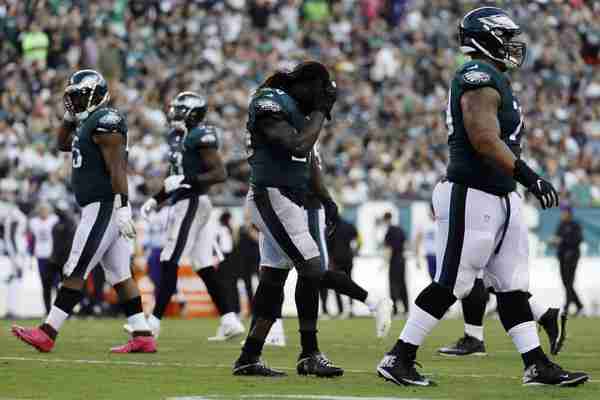
 Photo via PennLive.com
Since the conclusion of the 2018 NFL season, General Manager Howie Roseman and the front office have been making multiple moves to generate a better offensive production for the upcoming season. Philadelphia started their trek by trading for former Eagles wide receiver, Desean Jackson. By bringing Jackson back into the fold, it gives Carson Wentz a threat down the field, something Wentz didn’t exactly have last season.
Alshon Jeffery led the Philadelphia Eagles’ receiving corps in average targeted air yards (10.8) last season. Desean Jackson crushes that total with 19.1 targeted air yards, which led all qualified wide receivers in the NFL last season; a major upgrade for Wentz.
Desean Jackson has garnered 4,657 yards from deep passes over the past 10 years, outgaining the next-closest receiver by 1,259 yards (31%). Giving Carson Wentz one of the NFL’s premier deep threats could cause havoc for opposing defenses.
Howie Roseman’s next act was to improve at the running back position by acquiring 24 year-old Jordan Howard from the Chicago Bears via trade. Philadelphia gave up a 2020 sixth-round draft pick for the rights of Howard, which is yet another great move by Roseman. Howard is set to be a free agent at the end of the 2019 season, which gives the Eagles a great ultimatum. The team can either resign Howard, or they can choose to let the running back walk. If Howard enters free agency, the Eagles would likely receive a 2020 compensatory pick, a higher pick than the 2020 sixth-round pick that they gave up, for Howard’s departure.
The Eagles were rumored to still be in talks with free agent running back Jay Ajayi before the trade, however, this likely closes the door on Ajayi returning to the birds.
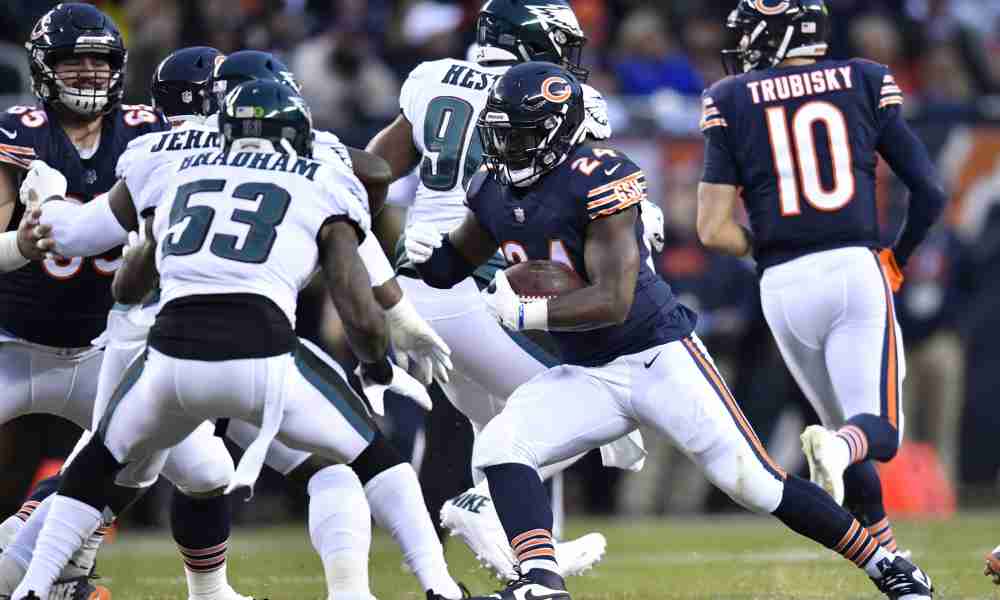
 photo via theeagleswire.usatoday.com
Howard is known for his size and strength, measuring in at 6’0″, 224 pounds. The former Bear is a tremendous runner between the tackles and has great awareness for finding holes. His combination of power and vision should give the Eagles a very strong option on first and second downs.
Over his young career, Jordan Howard has had multiple seasons in which he has rushed for over 1,000 yards. He also has a knack for the endzone, as he has scored 25 touchdowns in three seasons as the Bears’ running back. He averages 4.3 yards per carry over his career so far; a fairly decent output.
The downside to a player like Jordan Howard is that he supposedly lacks the ability to be a pass-catcher out of the backfield. Howard is aware of this as well. In his introductory press conference with the Eagles, he spoke on his catching abilities.
“My first two years I struggled to catch the ball. I admit that. But last year I worked on it a lot. I didn’t drop any passes,” Howard said to the media.
He isn’t exactly wrong, either. Howard’s catching percentage in his rookie season was a mere 58.0%. He improved, however, over his next two seasons as a pro by bringing catching percentage up to 71.9% in 2017, and then 76.9% in 2018. It will be very intriguing at how the Eagles decide to use Jordan Howard during the 2019 season.
With the NFL draft creeping up, Howie Roseman and the Philadelphia Eagles are far from over when it comes to adding talent to the roster. This offense has the potential to be a top-five unit once again. The birds are getting back their injured offensive weapons and adding new pieces to the puzzle simultaneously.
Just like every NFL season, we can’t perfectly predict the outcome of a team’s production before it happens, but we can surely estimate it. And as of right now, the Philadelphia Eagles offense seems primed for a comeback.
Photo: theeagleswire.usatoday.com
All statistics via profootballreference.com unless stated otherwise
Discover more from Philadelphia Sports Nation
Subscribe to get the latest posts sent to your email.

Categorized:Eagles