
How the Broad Street Bullies Became Stanley Cup Champions


This past Tuesday, May 19th, marked an iconic day in Philadelphia Flyers’ history.
This was the day that the Flyers became the first expansion team to win the Stanley Cup.
It was the day the original underdogs of Philadelphia skated faster. This was the day that the Broad Street Bullies beat the Big, Bad Bruins to become the 1973-1974 Stanley Cup Champions. How it happened, however, was not easy. It took a lot of work, determination, and passion- something we’ve become accustomed to in Philadelphia.
The Philadelphia Flyers’ arrival in 1967 seemed almost nonexistent. The blue-collar, obstinate town had no knowledge of ice hockey at first. The elements of iced water, a frozen disc of vulcanized rubber, shoes with sharp blades, and a wooden golf club-like object seemed foreign. At first, many doubted the success of the new franchise. Little did Philadelphians know that the Flyers would soon capture their hearts through the team’s grit, victories, and most remembered the Bullies’ rough and relentless style of play.

At the end of the first regular-season of Flyers hockey, the team finished just one game under .500, which was enough to earn first place in the weak Western Division. Throughout the year, the team gained momentum and a growing fanbase by beating Original Six teams such as the Montreal Canadiens and Chicago Blackhawks. The team proved themselves relentless and worthy of a playoff spot by playing many games on the road- for parts of the Spectrum’s brand new roof had been destroyed from wind damage. The Flyers faced the St. Louis Blues in the quarterfinals. The Blues brought a new, aggressive style to the ice that the Flyers had never competed against. The Blues tormented and annihilated the Flyers through intimidation and punishing hits. This proved to be too much for the Orange and Black, who lost the series. The same exact scenario occurred the next year. Owner Ed Snider had enough after the second consecutive playoff loss to St. Louis. “No team would ever intimidate us like that ever again,” he stated in a later interview.
In the 1969 amateur draft, bigger and tougher players were selected such as Don “Big Bird” Saleski and Dave “The Hammer” Schultz. Future Hall of Famer and elite goal scorer was also drafted in Bobby Clarke.
Three losing seasons followed, and the Orange and Black showed minimal fight and retaliation that we know and love them for today.

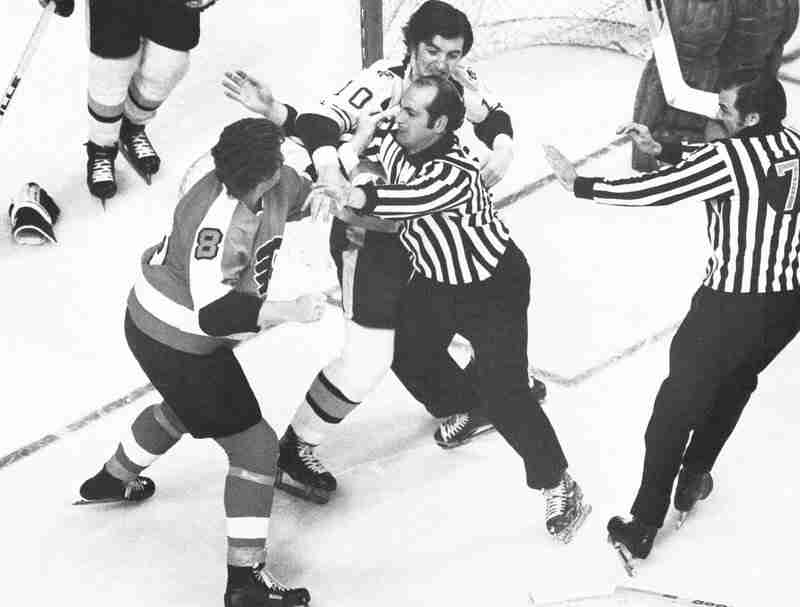
By the sixth season, the 1969 draft pick Dave Schultz moved up to the Flyers from the AHL’s Richmond Robins. His incomprehensible amount of spirit, fight, and penalty minutes triggered the same attitude among his teammates. Players now stood up for each other, pummeling the teams that used to bully them. “We used to play, win, fight, then drink their beer,” Schultz said in a later interview. Not long after the Flyers began earning an astonishing amount of penalty minutes at an extremely quick pace, Philadelphia Bulletin writers Jack Chevalier and Pete Cafone called the motley crew the Broad Street Bullies– and the name stuck ever since. Fighting had been a large element of the game since the beginning of the National Hockey League. What made the Flyers stand out from other fighting teams is that they became successful and won through aggression; not to mention the impressive offense generated from Bobby Clarke, Rick MacLeish, Gary Dornhoefer, Bill Flett, and Bill Barber, each scoring thirty goals or more. The Orange and Black improved their playoff luck by defeating the Minnesota North Stars in the first round but were eliminated in the semifinals by the Montreal Canadiens.
The last missing link in composing a championship team lied in the issue of consistent goaltending; the answer to that question returned to Philadelphia for the 1973-1974 season. General manager Keith Allen traded Doug Favell to reacquire Bernie Parent back from the Toronto Maple Leafs. Parent would have an unbelievable year, boasting twelve shutouts and a 1.89 GAA over the course of seventy-three games. Parent’s loving and optimistic personality brought something new to the team of aggressors, as well as the mysterious character of head coach Fred “The Fog” Shero.
Shero was a man a few words, who chose to talk to players through handwritten notes rather than verbal communication. Chalkboard displays in the locker room read “Take the shortest route to the puck carrier, and arrive in ill humor.” or “When you have bacon and eggs for breakfast, the chicken makes a contribution, but the pig makes a commitment.” These brainteasers were part of Shero’s genius way to get players to think and perform at the highest level possible. His most famous quote would be revealed prior to the puck drop of the year’s final contest.

The Flyers had it all now- brilliant goaltending from Bernie Parent, an evil mastermind in head coach Fred Shero, an endless stream of goals from Clarke, Lonsberry, MacLeish, and Barber, and not to mention spirited play established by Dave Schultz- which generated the whole team to play with the same energy. The Flyers easily swept the Atlanta Flames in the first round of the Stanley Cup Playoffs. The semifinal would be a huge test for the Orange and Black. The New York Rangers had been a pest for the Flyers, and they had only won one out of the previous nineteen games played at Madison Square Garden. The Rangers won all of their games at MSG. The Flyers won all of their games at the Spectrum. During a vital Game 7 at home, Barry Ashbee sustained a career-ending eye injury from a puck shot by New York Ranger Dale Rolfe. The tragedy caused Dave Schultz to brawl with Rolfe, who had no teammates come to his defense. Though the injury was an extremely unfortunate event, the energy created by Schultz pushed the Flyers to a 4-3 victory, with two goals from Gary Dornhoefer, and one each from Rick MacLeish and Orest Kindrachuk. Now came the final test for Lord Stanley’s Cup, which would be fought against the Big, Bad, Boston Bruins.
Game 1 in Boston belonged to the Bruins, thanks to a game-winning goal scored by Bobby Orr. Boston led for most of the second game at the Garden, up until the last minute in which Flyers defenseman Andre “Moose” Dupont tied the game. With momentum on their side, the Flyers became victorious in overtime with a goal from Bobby Clarke. “Turns out, it was the biggest goal of my career; but if you don’t win the series, it’s just another goal,” he later stated. The Flyers took advantage of the home ice at the Spectrum, winning the next two games to give them a 3-1 series lead. After a tough 5-1 Game 5 loss in Boston, the Flyers prepared for a do-or-die Game 6 in Philadelphia on May 19, 1974.

Displayed in the locker room beforehand was Shero’s popular chalkboard, which boasted his most famous quote “Win today and we walk together forever.” The team’s good luck charm Kate Smith sang her rendition of God Bless America before the matchup. Her song was used only in times of need- and this was one of them. The first and only goal of the game would be scored by Rick MacLeish in the first period. The Bruins outplayed the Bullies for most of the game, and had twice the amount of shots after the first period, leading 16-8. Therefore, the game’s true hero was Flyers goaltender Bernie Parent. Parent kept the Flyers alive, making save after incredible save. He recently reflected on the game-winning save on Bruins center Ken Hodge in an NBC interview:
“My mom was born on May 19th. My mom passed away on May 19th, and we won the Stanley Cup on May 19th. Isn’t that powerful? I’m sure it wasn’t me that made that save, it was my mom.”
The players, coaches, and many fans poured onto the ice as Gene Hart most famously yelled, “Ladies and Gentlemen, the Flyers are going to win the Stanley Cup!” The result of Game 6 was more than a victory or hoisting a legendary trophy. It brought the city together and gave it hope during an economically depressed time. It brought an estimated two million people together at the Stanley Cup parade, cheering and laughing together despite their differences.
The fun-loving, motley crew known as the 1973-1974 Philadelphia Flyers gave Philadelphians a reason to smile; a reason to stand up for each other; and most importantly, something to unite and rally around as one city.
Featured Image: PhiladelphiaEncyclopedia.com
Discover more from Philadelphia Sports Nation
Subscribe to get the latest posts sent to your email.

Categorized:Flyers Unique Columns