
Spencer Howard – The Good, The Bad, and The Reliever?


Spencer Howard, like many of us, has not had a good time in 2020.
In his first start for the Philadelphia Phillies, the 24-year old was rudely welcomed to the big leagues — giving up 4 earned runs on 7 hits in just 4.2 innings.
Unfortunately, Major League batters never became more cordial and the much-ballyhooed pitching prospect struggled in an injury-plagued rookie campaign that saw Howard post a 5.92 ERA over 24.1 innings of work. 2020 was supposed to be Howard’s grand arrival where he cemented himself in the 2021 starting rotation.
Instead, Howard failed to reach 5 innings in 5 of his 6 starts and saw his time-limited by a shoulder injury for the second straight year.
In an offseason that’s riddled with questions for the Phillies, what can we take away from Spencer Howard’s somewhat-foreboding rookie campaign?
The Good
Well, at only 24, Howard is still young. And last I checked, Howard is still a pitcher. No seriously, considering the absolute dearth of pitching prospects in the Phillies’ farm system, I’m counting this as an achievement. It’s also important to note that before 2020, Howard had never pitched above the AA level, only making the jump from High A Clearwater to AA Reading in 2019.
Moreover, Howard still possesses what at times can be an arsenal of plus pitches — the mid-to-high nineties fastball, a wipeout slider, decent curveball, and solid changeup — he did strike out 23 batters over those 24.1 innings.
The Bad
The problem in Howard’s pitching doesn’t so much reside in the quality of his arsenal, but rather in the consistency in it. As it stands, Howard’s array of plus pitches is nothing more than window-dressing to hide the larger issue — his inability to pitch deep into games. Framed by scouts as a fireballer with a four-seamer that sat in the mid-to-high nineties and would routinely hit triple digits, Howard’s fastball averaged 94.5 mph in 2020. While 94.5 mph is nothing to scoff at, the story behind the number raises some concerns. Howard’s four-seamer is relatively flat and is dependent on velocity and command to get past hitters. In multiple starts this season, however, Howard’s fastball velocity severely tailed off as the game wore on. All too often, Howard would dominate the first inning only to see his luck run out as his fastball velocity dipped into the low-nineties. Opponents batted .405 when facing Howard for the second time around, ballooning the righty’s 3rd inning ERA to 9.00. For Howard to be an effective rotational piece, he must be able to sustain his mid-to-high nineties fastball velocity over the course of a game.
Even more worrisome is Howard’s history of shoulder injuries. In 2019, Howard missed two months due to a shoulder strain and was put on the injured list again this September with shoulder stiffness. For a young pitcher who has never pitched more than 118 innings (2018) that struggles with fatigue and shoulder injuries, all signs point to Howard not being able to handle a full starter’s workload in 2021. As Howard is unlikely to reach 120 or even 100 innings in 2021 — for comparison Vince Velasquez threw 117 IP over 23 starts in 2019 — what’s next for the young right-hander?
The Reliever?
While the most sensible option for the Phillies would probably be to have Howard start the year down in AAA Lehigh Valley, there’s a high chance that the Phils cannot afford to do that. Plus the sensible option just isn’t as much fun to write about.
Yes, the Phillies need to develop Spencer Howard as a starting pitcher. There simply just isn’t the depth in the rotation for the long term plan to be anything but that. That being said, the Phillies also need to win. And they need to win now. Is it possible for them to do both things simultaneously?
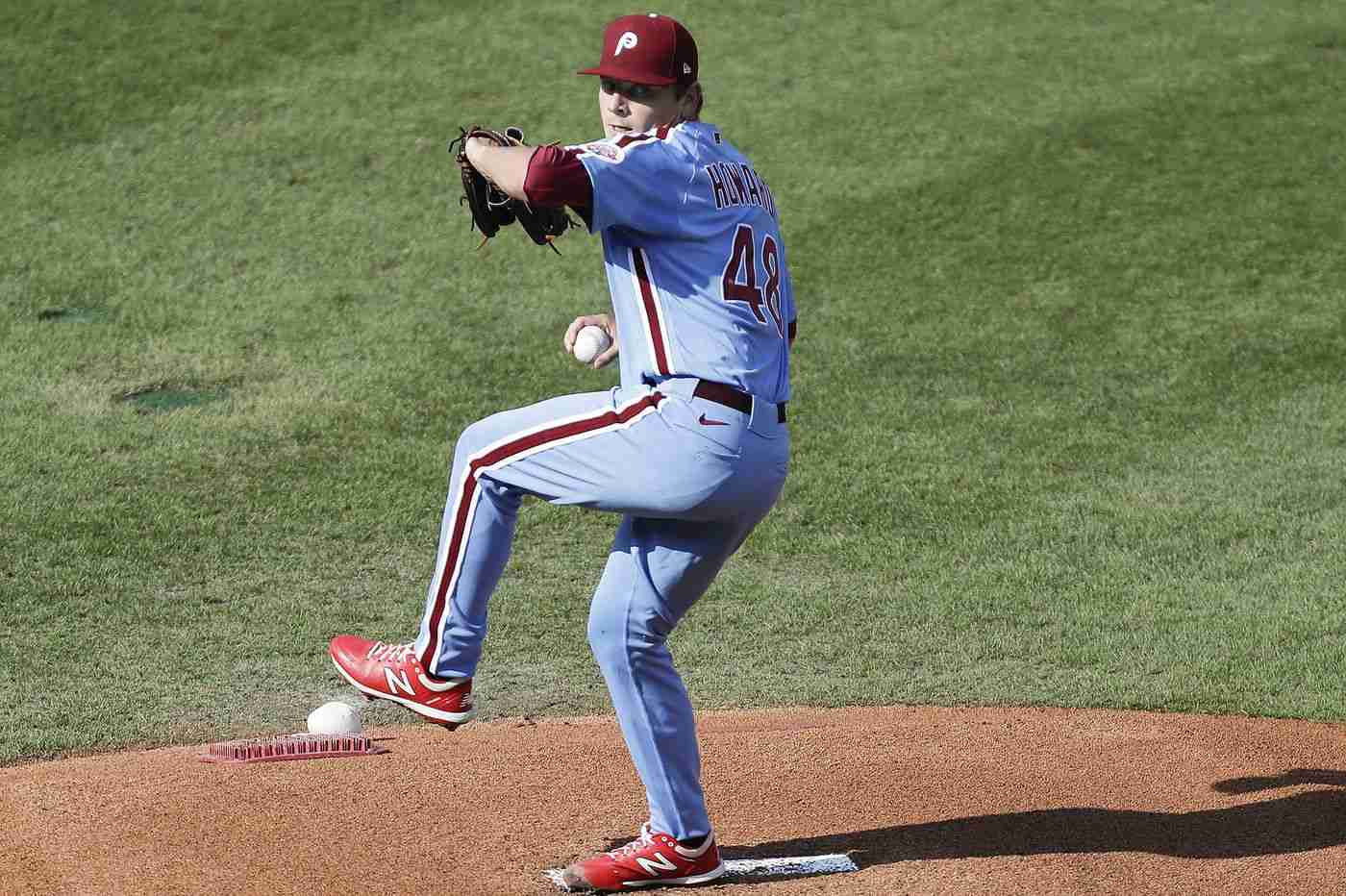
 Photo: Yong Kim/Philadelphia Inquirer
Perhaps. But not in the most conventional manner. Given Howard’s inability to maintain velocity and injury history, a stint in the bullpen may be the key to squeezing the most out of the youngster while continuing his development at the big league level. Out of Howard’s projected 100-121 innings pitched in 2021, how many of those are likely to be high-level starts that progress past the 5th inning? Not many. Instead of a streak of mediocre starts that wear on both Howard’s arm and those of our bullpen, why not use him as a hybrid middle-reliever/spot-starter? Howard’s stuff is face-value — it’ll blow you away the first time, but by the time the order turns over it’s cloudy with a chance of home-runs. In the bullpen, Howard could either overpower batters in late-inning situations or gain experience as the long-man when Zach Eflin inevitably gets pulled in the 5th. In double-headers or bullpen games, Howard could continue his development as a spot-starter with low expectations.
Howard clearly has the stuff to be a solid starting pitcher, but he’s not there yet. And that’s OK. The Phillies have spent far too long disregarding the warning signs and praying that their young pitchers will somehow establish themselves as effective pieces of the starting rotation. How many wasted starts did it take to prove that Vince Velasquez, Jerad Eickhoff, and Nick Pivetta weren’t long term solutions?
Why take the same chance with the organization’s most prized pitching prospect?
There’s an easier path that doesn’t involve thrusting Spencer Howard into a role that he’s not ready for — a path that starts just behind the center-field wall.
Featured Image: Yong Kim/Philadelphia Inquirer
Discover more from Philadelphia Sports Nation
Subscribe to get the latest posts sent to your email.

Categorized:Phillies