
Phillies Immeasurables – Part I: J.T. Realmuto


The television clicks on. A beer cracks open. The weight of a long day is exhaled as the Philadelphia Phillies come to life on the screen.
Then, a gnawing discomfort in the pit of your stomach. A few swear words are muttered under your breath.
The Phillies are losing again. And J.T. Realmuto isn’t even playing.
Shouldn’t this be different?
In the age of advanced analytics, today’s baseball fan has been made to sit down, shut up, and spoon-fed whatever graphics Statcast has put on the screen. The more data we have access to, the less we tend to trust our own judgment about the game — our fanhood rendered passive and reliant on statistics for every argument and explanation.
While I’m all for sabermetrics teaching me new things, there is one opinion that I can’t shake: how in the world are the Phillies going to function defensively without J.T. Realmuto? Could Realmuto’s defense be matched by cobbling together Andrew Knapp and another catcher? Is my anxiety warranted by the statistics?
Upon doing the empirical research, my anxiety does have validity.
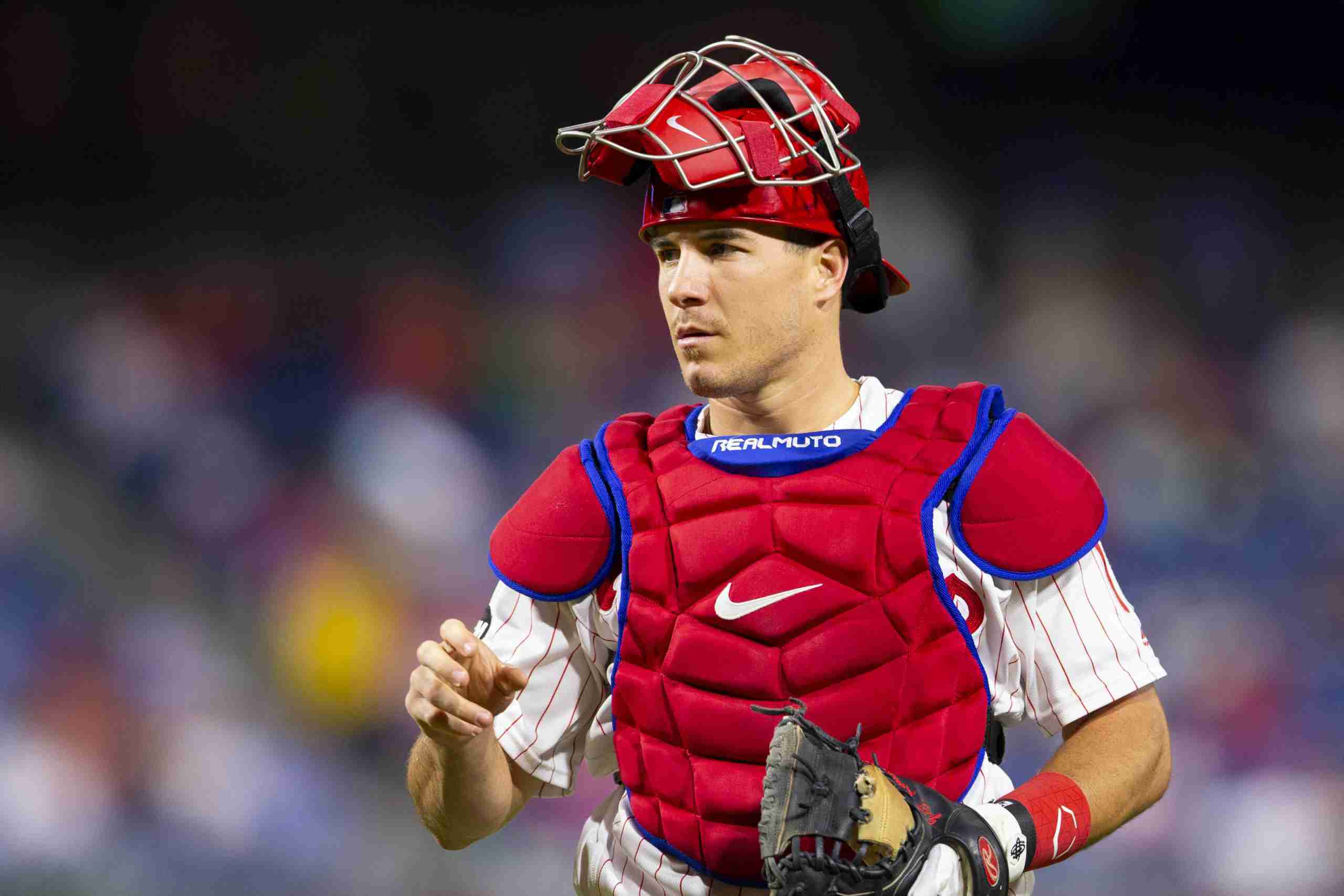
 Photo: Getty Images
The Phillies will suffer in both their defense and pitching if Realmuto doesn’t return. It doesn’t take a genius to figure that out. However, it is interesting how the Phillies pitching staff is quantifiably better when J.T. is behind the dish — despite the great strides Knapp has made defensively. Take in mind, too, that this analytics-based argument cannot account for the parts of J.T. Realmuto that are truly immeasurable — the game calling, leadership, and confidence instilled in his teammates when he is on the field. Some of a player’s best traits cannot be accounted for in the stat sheet. Nor is this an explanation of the offensive output the Phillies will suffer if J.T. doesn’t return. That’s more obvious and not quite as interesting. This is merely an effort to marry a season of the ‘eye test’ with the data that supports it.
The story starts and in some ways ends with pitch framing, an art at which J.T. is a savant and Knapp is rapidly improving. The ability to turn pitches on the outer edges of the strike zone into strikes is paramount in keeping pitch counts low and pitchers in the game. For a team that carries only 3 sure starters into next season and absolutely zero known bullpen pieces, young pitchers’ development will be critical. What do young pitchers often struggle with? Throwing strikes and combating high pitch counts. In 2020, JT ranked 2nd in all catchers with a 51.9% strike rate — a total of the called strike percentage he accumulated when framing pitches in non-swing zones. He also ranked 2nd in runs extra strikes with 3 runs generated from his successful frames on a rate of .125 run/strike. On the other hand, Knapp generated -1 runs from extra strikes and produced only a 45% strike rate on non-swings on the edge of the strike zone. Knapp’s framing is by no means poor but cannot compare to the level of Realmuto.
Furthermore, the pitching staff pitched better under Realmuto, posting a 4.92 ERA, than with Knapp behind the plate, where they had a 5.21 ERA. Additionally, Aaron Nola, Zach Eflin, and Zach Wheeler — the only certain rotation pieces in 2021 — all performed better when throwing to Realmuto. Is it just Realmuto’s pitch framing that boosts these numbers, or is there something intangible about his presence that imbues confidence in Phillies pitchers. Say, his game-calling or the fact that they were throwing to the Gold Glove winner in 2019?
A deeper look into the numbers creates even more disparity between Knapp and Realmuto’s defensive impact.
When Realmuto was in, the team’s batting average on balls in play or how effective the defense was at turning balls into outs was better, even if just marginally so, than when Knapp was catching. Even more, telling was the drop in opposing hitters’ slugging percentage when Realmuto was in as opposed to Knapp. Realmuto’s presence behind the plate lent itself to fewer hard-hit balls and extra-base hits, a byproduct of his pitch calling, pitch framing, and blocking skills.
Lastly, there is a difference in arm strength. Although 2020 was a down year for Realmuto in throwing out runners — catching 5 out of 15 base stealers — it’s the situation in which those bases were stolen that are important. Runners ran with a fear of Realmuto’s arm — only risking it when they absolutely had to — a 1.72 on the stolen base leverage scale as opposed to Knapp’s 1.15. More importantly, Realmuto caught runners when the team needed it most, posting a 2.19 on the caught stealing leverage scale to Knapp’s 1.68.
As strong of a season Knapp posted last year, it pales in comparison to Realmuto’s impact on the team’s defense and pitching. These statistics are only a small sample of how Realmuto’s defensive influence can be quantified, an effort to show in the language of modern baseball just how much Realmuto will be missed if not brought back in 2021.
The greater loss, however, beyond the defensive metrics, will be Realmuto’s intangibles — his presence on the field, in the clubhouse, and the city of Philadelphia.
That cannot be quantified.
Featured Image: Getty Images
Discover more from Philadelphia Sports Nation
Subscribe to get the latest posts sent to your email.

Categorized:Phillies